Often, a construction project needs temporary power before permanent infrastructure is connected. A remote operation might be working with limited grid access. A port or manufacturing facility can have periods of much higher energy demand. And as more equipment becomes electrified, businesses need to think differently about how that power is supplied, stored and available when it’s needed.
This is where Battery Energy Storage Systems (BESS) are becoming so important.
Volvo Penta’s BESS technology has been developed with these real-world applications at top of mind. Modular, transportable and energy-dense, it gives OEMs and operators another way to manage power across demanding industrial environments.
What does a BESS actually do?
Basically, a Battery Energy Storage System stores electrical energy so it can be used when and wherever it is required. But, on an industrial site, the need is far greater than just keeping a battery charged.
A BESS can support temporary power requirements, microgrids, charging infrastructure, data centre backup power, commercial and manufacturing facilities and applications requiring flexible power on demand. It can also be integrated alongside other energy sources as part of a wider power system.
It needs to be flexible, because industrial sites don’t all operate the same way. Their power requirements can change throughout a project or even during the day.
Built for sites where conditions aren’t easy
Industrial equipment is rarely located in a perfectly controlled environment. Dust, corrosion, movement, limited space and remote locations can all influence the type of power solution that will actually work on site.
Volvo Penta’s BESS subsystem is designed specifically with challenging environments in mind. The system incorporates protection against dust and corrosion, while its thermal management system helps maintain battery performance across different operating environments.
Importantly, energy density is also a major part of the design.
If space is limited or equipment needs to be moved, being able to store significant energy without requiring an unnecessarily large footprint can make BESS the most practical option.
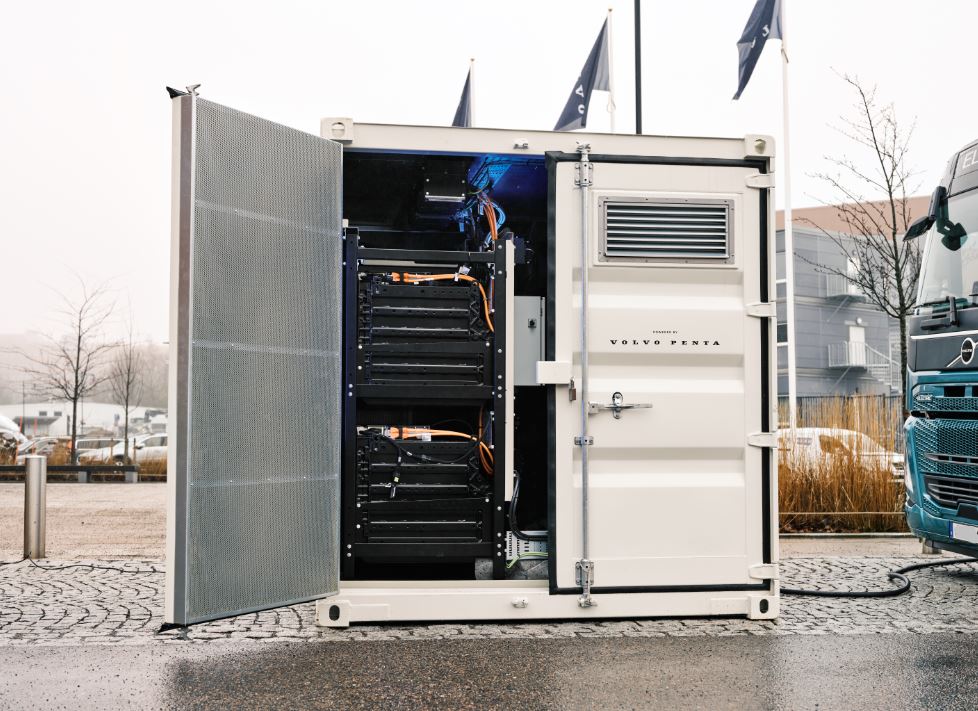
Power that can move with the job
Not every industrial power requirement is permanent. A construction site passes through different stages. Temporary infrastructure comes and goes. Equipment may need charging away from established electrical infrastructure. Disaster recovery and events may need a lot of power in locations that weren’t designed to provide it.
Volvo Penta BESS solutions are modular and transportable, allowing stored power to be deployed where it is required instead of just relying on fixed infrastructure.
Different battery pack configurations allow systems to be scaled for different applications, from a three-battery pack configuration through to larger containerised systems. A hybrid configuration combining a 5 ft BESS with a Volvo Penta D8 genset is another option for applications where stored energy and conventional generation need to work together.
Where can BESS be used?
One of the biggest advantages of BESS is just how many different power challenges it can help solve. With efficient energy storage and the ability to rapidly charge and discharge, Volvo Penta BESS can provide dependable, transportable power in demanding industrial environments.
Applications can include:
- Temporary power requirements
- Microgrids and public sector applications
- Charging infrastructure
- Data centres and backup power
- Flexible power on demand
- Commercial and manufacturing operations
- Frequency regulation
For businesses, this flexibility means energy can be stored when it’s available and delivered quickly when demand increases.
Supporting the move towards electrification
A challenge facing industrial electrification isn’t just replacing one piece of equipment with an electric version. You also need the infrastructure to reliably power it. This can be challenging in industries such as construction and ports, where electrical demand can be high, and existing grid capacity is limited.
BESS can help bridge that gap. For example, a transportable system can provide charging support for electric machinery in remote locations or areas where connecting directly to sufficient grid capacity isn’t practical. BESS can also work within a microgrid alongside renewable energy or other generation assets to provide more stable energy availability.
For operators, that means electrification doesn’t necessarily have to wait for permanent infrastructure to catch up.
More than just the battery
For industrial applications, storing energy is only a part of the equation. Managing it safely and effectively is just as important.
Volvo Penta’s BESS subsystem brings together battery packs with a Battery Management System (BMS), DC/DC converter, monitoring technology, thermal management and electrical safety protections. Its monitoring capabilities provide visibility over the system, while the BMS is designed to support performance and battery longevity.
The modular approach also gives OEMs flexibility when integrating BESS into a broader solution rather than forcing every operation into the same configuration.
Behind the technology is the scale of the Volvo Group, with Volvo Penta’s BESS offering benefiting from investment in battery cell manufacturing, battery pack development and large-scale production.
Finding the right BESS solution for your operation
The real value of BESS isn’t just having batteries accessible on site. It’s finding the right way to integrate energy storage into the way your operation works.
Oceania Power works with Volvo Penta and OEM partners to develop BESS solutions around specific industrial requirements, from temporary and off-grid power through to microgrids, charging infrastructure, backup power and high-demand applications.
Looking at how battery energy storage could work within your operation? Contact Oceania Power to discuss your site, power requirements and the Volvo Penta BESS options available.